
Clinical protocols at the point of care

Your team’s protocol, at hand for every decision.

Clinical pathways with explicit criteria, at hand during care. One shared protocol for the team, with the source behind every step and room for clinical judgement.

The pathways run on explicit clinical rules. They do not need AI to decide which route to display.

A nurse and a patient review a tablet together during a consultation.
01 / In consultation
Why now

Evidence needs to reach the point of decision.

Under pressure to deliver care, applying a guideline means searching, interpreting, checking and documenting. That workload competes with attention to the patient. Organisations need processes that depend less on individual memory.

GuideCare brings the guideline into the care process to support decisions with explicit criteria and turn activity into useful information. For clinicians, support during care. For managers, practice they can review and improve.

Process efficiency
Ordering the steps and avoiding repeated searches and documentation helps free up time for care.
Lower cognitive load
Showing relevant information and checks at each step reduces the need to remember everything while caring for a patient.
Support for safer decisions
Deterministic, transparent and traceable rules make the reasoning behind each step open to review. The team validates the content and clinicians retain their judgement. Executing these rules does not require AI.
Organisational consistency
Shared, versioned protocols help reduce unwarranted variation between teams. Documenting clinical exceptions distinguishes a necessary adaptation from a process that needs review.
Coded clinical activity
Structuring and coding the care delivered using shared terminologies supports continuity of care and information exchange. It also enables teams to evaluate activity using comparable criteria.
01 / Nursing autonomy

Autonomy to resolve cases within a defined scope.

GuideCare supports nurses in independently executing protocols within their professional scope of practice. It brings closed, predefined protocols into care, with regulatory validity for their intended setting, to assess patient symptoms, resolve clearly delimited use cases and perform procedures.

Each protocol specifies which patients and situations it covers, which actions nurses may carry out and when referral or further assessment is required. Cases are resolved within that scope, with the steps and closure documented. The organisation validates the content and its compliance with applicable regulations before use.

Illustrative workflow · Defined use case
01Assess symptoms and check inclusion criteria
02Check exclusions and scope of practice
03 / RESOLUTIONExecute the protocol and close the caseWithin nursing competencies and the approved scope.
03 / REFERRALRequest the appropriate assessmentWhen the case is outside scope or meets a referral criterion.

Entry criteria, actions, procedures and closure conditions defined in advance. Professional competencies remain unchanged.

02 / The product

Defined protocols, from validation to case resolution.

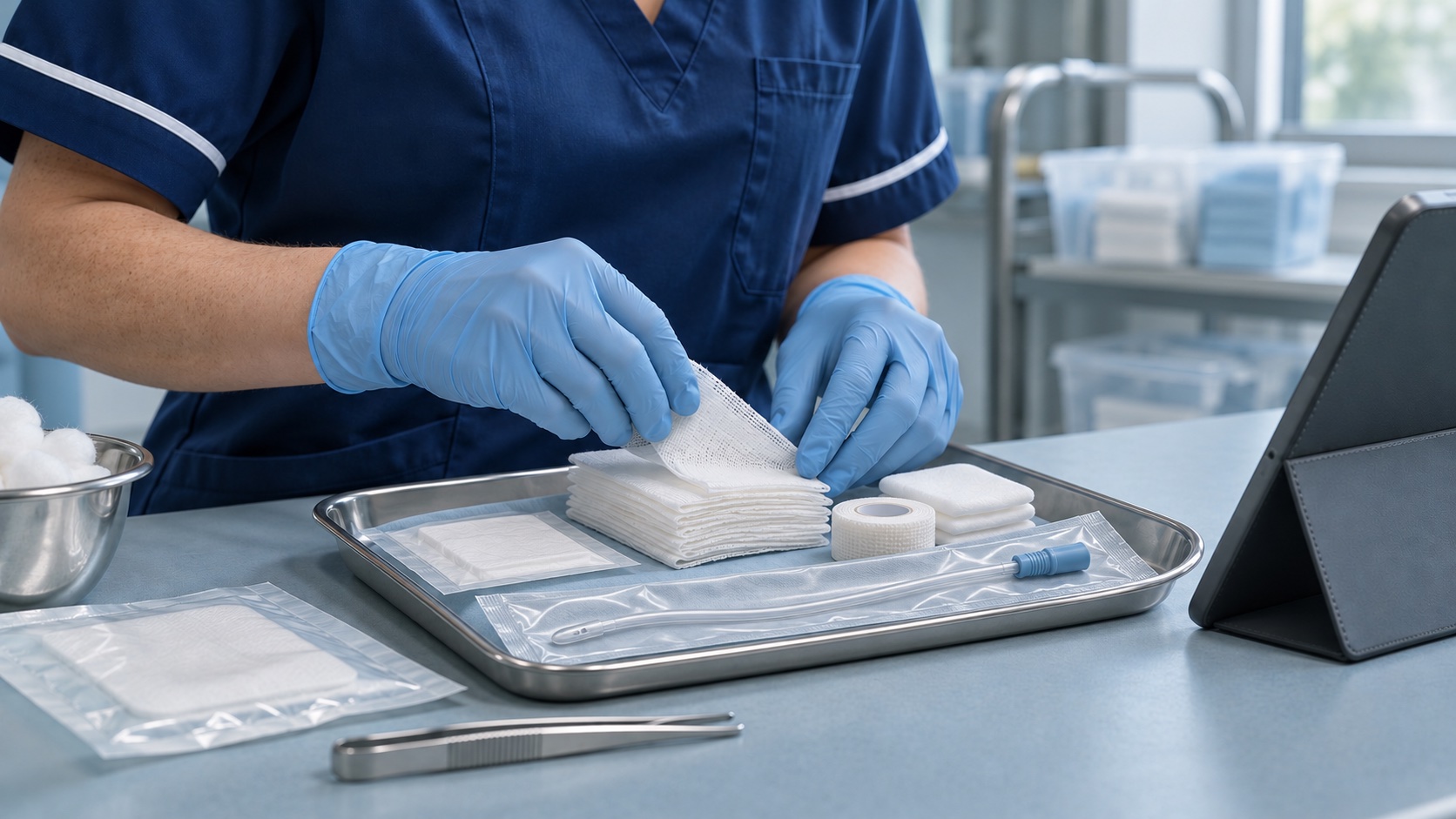
A healthcare professional prepares a clinical tray with a catheter in its sterile packaging.
02 / Preparing for careGuideCare
03 / Who it is for

One protocol, two responsibilities.

For clinical teams

Decide with the protocol at hand.

Assess symptoms and execute defined protocols and procedures within your scope of practice. Consult inclusion criteria, specified actions and closure conditions. When a case is outside scope, initiate referral and record the reason.

For healthcare managers

Maintain a shared approach across sites.

Define which version teams use, who endorses each recommendation and what changes with each update. Review the steps that generate the most deviations and distinguish justified adaptations from points that need clarification in the protocol.

04 / Rules and clinical oversight

Deterministic, transparent and traceable pathways.

With the same protocol version and the same answers, GuideCare always displays the same route. The pathway follows rules defined and approved by the clinical team. It does not need artificial intelligence to execute those rules.

Transparency

Understand why each step appears.

Clinicians can see which criterion activates the route, its source and who endorses the protocol.

Traceability

Identify which version was used.

Each step links to a protocol version. When the team publishes a revision, it can check what changed and consult the updated criterion.

Designed to support safer practice, with explicit escalation criteria and room for clinicians to document adaptations.

Interoperability and terminology

A shared clinical language.

HL7 FHIR is GuideCare’s standard for exchanging clinical information. To represent the meaning of data, it uses LOINC®, SNOMED CT and ICD-10 to structure the clinical information in protocols, alongside official medicines information from Spain’s AEMPS through CIMA.

Trademarks and reference frameworks

LOINC® is a registered trademark of Regenstrief Institute, Inc. SNOMED CT® is a registered trademark of SNOMED International. HL7® and FHIR® are registered trademarks of Health Level Seven International. openEHR® is a registered trademark of the openEHR Foundation. ICD-10 is the World Health Organization’s International Classification of Diseases. AEMPS and CIMA identify the Spanish Agency of Medicines and Medical Devices and its Medicines Information Centre. ENS refers to Spain’s National Security Framework. All trademarks and names belong to their respective owners and are mentioned to identify standards, terminologies, information sources and reference frameworks. Their mention does not imply sponsorship, institutional endorsement or certification of GuideCare.

A healthcare professional consults a tablet in a clinical setting.
05 / Professional judgement

The protocol guides. The clinician decides.

A guideline brings together evidence for common situations. During a consultation, clinicians interpret it in light of their observations, the patient’s history and preferences. GuideCare lets them document the reason when they adapt the pathway.

06 / Evaluation

Start with a decision that varies between teams today.

Bring a protocol and a specific decision point. In a demo, we can explore it using simulated cases and agree what would be worth evaluating in your organisation.

Does it work in consultation?

Check how long it takes clinicians to find the current criterion, whether they recognise when to escalate and whether they can explain an adaptation without losing the context of the visit.

Can we govern it?

Define who approves and updates the pathway. If you plan a pilot, compare use of the current protocol and reasons for deviation across teams against a baseline.

A male nurse and two colleagues review a protocol together.
03 / Reviewing the protocol together
Who is responsible for the content?

The organisation identifies the team that approves the version, its sources and escalation criteria. The authors of a guideline and the body approving a local protocol may be different organisations.

What needs clarifying before use with patients?

The scope of use, integration with the health record, the data involved, security conditions and applicable regulatory requirements. The demo on this page uses simulated examples.